Average Reviews:

(More customer reviews)Robert F. Kennedy was adored by the masses when he won the primary for the Democratic party, on his way to becoming the president. Then, like his presidential brother, he was gunned down in public. (That was WAY before I was born, so much of what I know comes from books)
Emilio Estevez doesn't exactly focus on that in "Bobby." Instead, he creates an elaborate "Grand Hotel"-style plot, focusing on the people who surrounded Kennedy on the last day of his life. The movie is a little scattered throughout the first parts, but Estevez yanks it together in time for the inevitable, tragic denouement.
The entire movie takes place on one day: June 4, 1968. The place: Los Angeles' Ambassador Hotel. And there's as much drama out of the campaign as in it: For example, the manager (William H. Macy) is cheating on his smart beautician wife (Sharon Stone) with the switchboard girl (Heather Graham), but takes some time out to fire a racist supervisor (Christian Slater) because the guy won't let the black and Latin employees vote.
The doorman (Anthony Hopkins) and his pal (Harry Belafonte) play chess and talk. A lounge singer (Demi Moore) is struggling with alcoholism, a young girl (Lindsay Lohan) is marrying a guy she doesn't love (Elijah Wood) to keep him from going to Vietnam, and campaign workers drop acid. Their stories are only loosely intwertwined -- until Sirhan Sirhan arrives.
Estevez has created a movie that Tries To Have It All. It tackles racism, war, love, voting, women's rights, and the adored icons of an era. It also stars just about every kind of actor: veterans, Bratpackers, ex-sexpots, MTV stars, party girls and accomplished young actors.
In fact, "Bobby" spills over with plot and characters, and for the first two thirds, it seems that there is almost too much of EVERYTHING. But Estevez captures the you-are-there ambience, with crisp suits and longer dresses, neat hair, period music and the occasional baseball reference. For a day, you ARE in Los Angeles in 1968.
And he has a knack for creating a sense of foreboding and sadness, which hangs independently of the characters. Yet in some scenes where Kennedy is supposed to be speaking, the shining eagerness that you see in the audience's faces is enough to bowl you over. It captures the hope that was present during that era, and afterwards died quickly, as hope usually does.
The enormous cast makes it hard to single out one, but there are several good ones: Laurence Fishborne and Freddy Rodriguez as cooks who discuss the racism they struggle with, Macy as the manager who struggles to regain his lost youth by an affair, Stone as his faded beauty of a wife, and Wood's bittersweet, ironic portrayal of the young groom.
Kennedy himself is a nebulous figure -- most of what we see are archival clips, which show the young candidate's charisma and power. Although "Bobby's" take on him is rather naive, it does leave you wondering how he might have changed the US, had he lived.
"Bobby" is high on ambition, and Estevez manages to create a truly poignant, thought-provoking film. It has its flaws, but it also captures a shocking moment in American history.
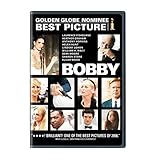
Click Here to see more reviews about: Bobby (Widescreen Edtion) (2006)
(Drama) A re-telling of the assassination of Senator Robert F. Kennedy at the Ambassador Hotel in 1968. The film follows 22 individuals who are all at the hotel for different purposes but share the common thread of anticipating Kennedy's arrival at the primary election night party, which would change their lives forever. This historic night is set against the backdrop of the cultural issues gripping the country at the time, including racism, sexual inequality and class differences.
 Get 22% OFF
Click here for more information about Bobby (Widescreen Edtion) (2006)

0 comments:
Post a Comment