Average Reviews:

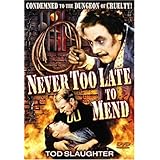
(More customer reviews)The passing years have unjustly consigned him to relative obscurity, but Tod Slaughter never failed to deliver a tour de force performance that practically personified villainy. The man had it all - the eminently tweak-able mustache, the dramatic (some might say melodramatic) facial expressions, the masterful smirks, the perfectly dark, gleeful laugh, and a panache that goes unrivalled still today. In this 1937 film, he was in fine form indeed, scheming his schemes, enjoying his local power in the community, and - this time around - dispensing justice the Tod Slaughter way.
Slaughter plays the wealthy Squire Meadows, a stalwart fixture in the local community who also serves as justice of the peace and administrator of the local prison. Hiding his villainy behind a mask of nobility and indulging his dark side in the form of prisoner discipline just isn't enough to satisfy him, though. He's in love with a young lass named Susan Merton (Marjorie Taylor) - but she is in love with a poor farmer named George Fielding (Ian Colin). That's okay, though, because Tod Slaughter always has a plan - J.R. Ewing could take a few lessons from Tod Slaughter. Even though part of his first plan doesn't work out, Fielding gives the good Squire time to rethink his approach by taking off for Australia for a couple of years, aiming to make something of himself and then return to claim his bride. During that time, Meadows ingeniously manages to insinuate his good graces into the Merton family, intercept all of the young lovers' letters back and forth, and cast ruinous gossip about George Fielding all over town. All the while, he is there to comfort Susan and butter up her father. It's the perfect plan.
The film is best known for its depiction of harsh prison conditions. Tod Slaughter is purely in his element as he's threatening prisoners (young and old) with "the cat," having them thrown in the "Black Hole," or sentencing them to 1800 turns of the crank a day and a week on bread and water. In this capacity, the film is based on Charles Reade's novel Never Too Late to Mend, a book that characterized the abuses and depravity of prison justice so effectively that it inspired Queen Victoria to call for a complete overhaul of the system.
Historical context aside, though, Tod Slaughter really makes the entire film. When is the last time you saw a villain on film and felt as if the guy truly enjoyed every facet of his evil ways? It is that unmatched spirit of devilish glee that shines through every second of a Tod Slaughter performance that makes him the archetype and the embodiment of true villainy - and makes this and every other Tod Slaughter film a must see.
Click Here to see more reviews about: Never Too Late to Mend

Click here for more information about Never Too Late to Mend

0 comments:
Post a Comment