Average Reviews:

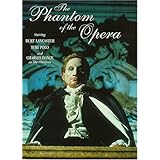
(More customer reviews)This two-part televison version of "The Phantom of the Opera" is a mixed bag to be sure, but it does have its moments. Clearly this is a post-Lloyd Webber version of "Phantom," highlighting the romance between the title character (Charles Dance) and Christine (Terri Polo) even more than the Broadway show. For once, the love triangle between teacher, pupil and Philippe (Adam Stroke), the Count de Chagny, is realistic; which is to say, Christine really has a choice between the two men who command her affection. Of course, the paradox is that the more romantic a figure the Phantom becomes, the less he can be seen as a deadly maniac roaming at will through the Paris Opera House. The result is that when this Phantom kills intruders into his subterranean realm, I found it hard to believe because it went against Erik's character (cf. the 1989 film version with Robert Englund of Freddy Krueger fame).
One of the strengths of the film is the use it makes of the opera part of the title. There is a wonderful scene early when Christine has come to the big city and has joined the chorus of the Opera. One evening she is signing at a local tavern and the managers of the Opera House convince Carlotta (Andréa Ferréol), the egotistical diva, to go up and sign with the girl. However, it does not take long for Christine to blow Carlotta away, and when the diva flees from the stage we have clear proof as to who has more talent. The finale of the mini-series involves a production of Charles Gounod's "Faust," which is one of the best uses of an opera in a film since a production of "La Traviata" popped up in "Pretty Woman." The choice of "Faust" is a masterstroke, not just because the opera is actually sung in French, but because there are some strong parallels between the story of Faust and that of the Phantom. This allows for a rather surprising and haunting use of the opera's climatic aria.
I know there will be strong disagreement on this score, but I also appreciated this version's approach to the Phantom's disfigurement. There is a pivotal scene early on when Christine actually tries to persuade Erik to remove his mask, maintaining that she can look at whatever is beneath it with eyes of love. When the mask is removed the focus is not on his face but rather on Christine's as she bases from shock to horror to senselessness. It is that look, along with Erik's cry of anguish, that carries the scene. More importantly, it sets up an even better scene at the end of the film. That first scene is clearly influenced by the Broadway version, where the audience never sees the Phantom's face at that point, just Christine, rather than the immortal scene where Mary Philbin unmasked Lon Chaney in the classic silent version. Meanwhile, the film's conclusion actually harkens back to Gaston Leroux's original novel with regards to how Christine conquers Erik.
Editing this film down a bit would certainly be helpful; the four-hour mini-series loses about an hour once you take out the commercials, but could benefit from losing another half-hour or so. The performances are competent, with Dance evincing charm as the Phantom without a real undercurrent of menace. Polo is a tad too emotional at time and has a lot of lip-synching to do with all the opera singing, but there is an earnestness that matches the character. Stroke has the unenviable tasks of trying to convince both Christine and the audience that she should pick his character instead of the Phantom. Most of the supporting cast are assigned various roles of comic relief with French accents, while Burt Lancaster gets to bring some dignity to the proceedings as the former manager of the Paris Opera House who knows more about the Phantom than anyone knows.
The key thing is that this 1990 version of "The Phantom of the Opera" is not going to be the first one you view. You have to see Lon Chaney's silent version and at least listen to the Broadway musical (paying copious attention to the libretto so you know exactly what is happening). The 1943 Claude Reins film involving acid being thrown and music being stolen is optional. But the more you are familiar with the various tellings of this tale, the more you can enjoy what writer Arthur L. Kopit and director Tony Richardson ("Tom Jones").
Click Here to see more reviews about: The Phantom of the Opera (TV Miniseries) (1990)

Click here for more information about The Phantom of the Opera (TV Miniseries) (1990)

0 comments:
Post a Comment