Average Reviews:

(More customer reviews)I've held off writing about Dr. Atomic. I've now watched it for the third time and haven't changed my mind. It's a masterpiece. There's no denying some of the power of the score, but it is in the many more introspective moments that I find its most arresting beauty and power.
Gerald Finley - a singer I went nuts for as Papageno nearly 20 years ago, still has a marvelously appealing boyish handsomeness that suits this role to a tee. This could be the role of his career so far. The voice is in absolutely peak condition, one of the most beautiful baritones singing today (in my opinion) with a winning combination of brightness, mellowness, one of the most even-sounding vibratos of any singer today and a light rich quality that simply gleams. His body was made for the stage, moving with a relaxed athleticism, and knows how to strike a pose that hits you like a spotlight. In many regards, his intensity reminds me of another favorite singer of mine, Lorraine Hunt Lieberson in that his gestures - while highly theatrical, seem germane, perfectly suited to the character - as though they could not be performed any other way. This is star quality that elevates a performance to greatness.
The most powerful moment for me remains the ending of the first act, Oppenheimer's brilliant prayer/aria "Batter my heart, three person'd God." I cannot watch this without tears pouring from first to last. The music itself is remarkable, but combined with Finley's voice, and passionate interpretation, the heightened sense of movement by Peter Sellars and the staging itself, it becomes nearly unbearable in its intensity and beauty. With the bomb behind a curtain, like some templed sacred object behind a veil, Oppenheimer slowly approaches the veil, then turns and falls, and repeats the a series of gestures, each time with increasing intensity rising, falling, beating his heart with fist, hands to his head, then again approaches the veil. Following the final verse, he enters the veiled room, left in silhouhette, his hand raised towards the object itself. It is one of the most beautifully powerful stagings of an aria I've experienced.
Richard Paul Fink is another of my favorite singers and his beautiful bass sound, remarkable diction and fine dramatic instincts make his portrayal of Teller as important as the central role of Oppenheimer, particularly in the first half. Jessica Rivera is simply amazing as Kitty Oppenheimer, her first aria "Am I in your light," as the couple is in bed, her husband trying to study, offers a stunning contrast to all of the music before it. Oppenheim gives up his reading, and responds to her, climbing over and gently caressing her with stanza from Baudelaire. It is a quiet, intimate and beautiful moment.
Eric Ownes offers a richly detailed, entirely believable performance as General Groves, expressing his frustrations, concerns, detailing his weight issues (complete with calorie counts!) in that gorgeous, sonorous baritone of his.
The remainder of the cast, James Maddalena, Thomas Glenn, Jay Hunter Morris, and particularly the oddly moving performance of Ellen Rabiner as Pasqualita, are all up to the same level as the central roles.
I have some issues with the staging, and could have easily been happier if Lucinda Childs' incessant choreography had but cut - by at least half. Some of it is highly effective, such as the angular, ritualistic movement out in the desert, but much of it appeared as though a rehearsal for the Jets and Sharks were taking place at the rear of the stage while an opera was going on.
The chorus of De Nederlandse Opera sings English about as well as any English speaking chorus, and the musical direction of Lawrence Renes with the Netherlands Philharmonic rises to the level of Adams' remarkable score.
If I've any gripe (outside of the unnecessary choreography) it would be one I've made of many live performance videos: no curtain calls or opportunity to see - and share in - the audience's reaction. This is a bad move in my opinion. I understand by the end of viewing this how emotionally drained a viewer can be - I was exhausted - but there were several thousand people cheering this and, apparently, an enormous ovation for the performers. I find it a bit rude as well not to allow these people who'd offered these intense, blazing performances for three hours of a difficult score, the opportunity to take a bow in our respective living rooms.
There are a bunch of extra features, mini documentaries, and interviews that make this an exceptional DVD purchase for anyone interested in the future of opera. A truly overwhelming operatic experience.
Click Here to see more reviews about: John Adams: Doctor Atomic (2008)
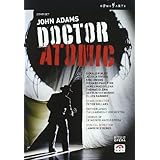
The longing to overcome human boundaries lead the physicist J. Robert Oppenheimer to begin an experiment that formed a threat to the whole of humanity, and whose scientific results still do today. The question of the moral implications of the atomic bomb is raised in John Adams opera, just as much as that of the influence on the private lives of the main characters. Doctor Atomic is the fifth work to result from almost twenty years of collaboration between the American composer and his fellow American director and Erasmus Prize-winner Peter Sellars. Doctor Atomic concerns itself with the work of J. Robert Oppenheimer and his team of scientists at the test site of the first atomic bomb outside Los Alamos, New Mexico during the lead-up to the first detonation. As Zero Hour relentlessly approaches and conditions become less and less favorable, individual tensions build feverishly and Oppenheimer and his staff struggle with the moral implications of their work on 'the Gadget', and the strong possibility of global annihilation. Recorded in high definition video and true surround sound, John Adams' fascinating, overwhelming score and Peter Sellars' forceful staging (and TV direction) portray Oppenheimer, exquisitely sung by Gerald Finley, as a profoundly troubled man, at odds with himself but moving inexorably forward, representative of the great ethical dilemmas of humanity itself.
 Get 28% OFF
Click here for more information about John Adams: Doctor Atomic (2008)

0 comments:
Post a Comment