Average Reviews:

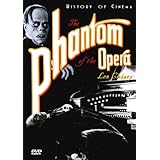
(More customer reviews)Although marred by static direction and stilted acting, the 1925 silent film THE PHANTOM OF THE OPERA is known primarily for the memorable contribution by Lon Chaney as an actor and makeup artist. His moving portrayal of the disfigured escaped convict who haunts Paris Opera House is perhaps the sole reason to watch this film. And his talent as a makeup artist helped create one of the most indelible images in film history: the skull-like head of the phantom that conveys sadness, anger, and horror at the same time. This Region-1-only 2-disc DVD set from The Milestone Company includes two versions of this classic film: the 1925 version that was premiered in New York, and the 1929 re-edited silent version that is most often seen today. The DVD also contains excellent supplements that give us a good overview of the film's rather remarkable history.
The rarely seen 1925 New York premiere version included on this DVD is untinted, runs 107 minutes, and was transferred from the only surviving 16mm reduction print. Its video quality is understandably poor; sharpness and clarity are never satisfactory, and blemishes abound. There are some notable differences between this version and the shorter, 93-min, 1929 re-edited version. In the 1925 version, actors are introduced via their own title cards. There is no "Carlotta's mother" character. Carlotta is played by Virginia Pearson in both the opera and the dramatic scenes. The chandelier sequence is edited more competently and thus played out a little more effectively. There are more scenes in Christine's dressing room, so adequate suspense is built up before she meets the phantom. There is also one crucial scene in a garden that explains why Christine is so enamored to the mysterious voice she hears. In my opinion, the 1925 version is the superior version; it seems more complete and satisfying narratively than the edited 1929 version.
The 1929 edited silent version included on this DVD was transferred from a restored, re-tinted print made by the renowned film restoration company Photoplay Productions. This is the best-looking version of PHANTOM to date. It also looks much sharper and cleaner than the 1997 Image DVD. Both DVDs offer the speed-corrected 1929 version, but the '97 Image DVD opens with a shot of a man holding a lantern walking past the camera, while the Milestone DVD, curiously, omits this so-called "lantern man" shot and opens at the opera house. On both DVDs, the "Bal Masque" scene is shown in two-strip Technicolor, with the color on the Milestone disc looking a little more realistic. Also, in order to duplicate the original film as much as possible, some of the color scenes on the Milestone disc were actually digitally colored (such as the phantom's red cape at the roof of the opera house), because there is no existing color footage for them. On the '97 Image DVD, no digital coloring was used.
There was a "talkie" version of PHANTOM made in 1929, but unfortunately the print of that version was lost. The dialogs and sound effects recorded for that version, however, survived. To give the viewer a taste of the sound version, the Milestone DVD offers something interesting to accompany the 1929 silent version: a soundtrack composed of fragments of existing recordings of the sound version pieced together to fit the silent version as much as possible. The result is still far from being a "talkie" track. It has plenty of sound effects and spoken dialogs, but it has almost no synchronized talking. Inter-titles are still present (because this is still the silent version). There is, however, one opera sequence where the singing of actress Mary Fabian (who did her own singing) is perfectly synchronized with the picture, which is a wonder to watch. The DVD also includes audio-only supplements of recorded dialogs, which give us further glimpses of the talkie version -- and of its rather incompetent voice acting.
Also accompanying the 1929 version is a superb audio commentary by PHANTOM expert Scott MacQueen. He provides a wealth of information about the production history, the backgrounds of the cast and crew, the various versions of the film, the use of color, and the use of sound. He deplores the incompetence of director Rupert Julian, and emphasizes that the true auteurs of the film were Chaney and set designer Ben Carré. He points out that contemporary reviews indicate that the 1925 version contains Technicolor sequences in not only the Bal Masque scene, but also the opera sequences and the auditorium scenes (the extensive use of color must have been quite a spectacle for a silent film back then). He recounts in great details (while speaking at a pretty fast pace) how the various versions of PHANTOM survived over the years -- the existing 1925 version originated from the so-called "Show-at-home" 16mm versions which Universal made for private collectors in the 1930s, while the surviving 1929 version was obtained by a Jim Card at Universal in the 1950s, and the Technicolor sequences was obtained from a 1930 dye transfer copy by restorationist David Shepherd.
To add even more value to an already superb package, the Milestone DVD also includes still-frame reconstructions of the Los Angeles and San Francisco premiere versions of PHANTOM. These were the very first public showings of the film. The Los Angeles version ended not with a chase scene as in later versions, but with the phantom dying alone at his piano.
Click Here to see more reviews about: The Phantom of the Opera
Lon Chaney's stunningly memorable performance as a terribly deformed phantom with a soft spot for music and a beautiful singer make this film a truly unforgettable cinematic experience worthy of being called a quintessential horror film. Featured on AFI's list of "100 Years, 100 Thrills." Collectible poster included

Click here for more information about The Phantom of the Opera

0 comments:
Post a Comment