Average Reviews:

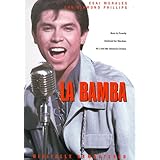
(More customer reviews)Movies about entertainment icons can be very promising, but at the same time misleading.
Such can be said about the talented 17 year old Ritchie Valens (Richard Steve Valenzuela) of Southern California. The Ritchie Valens story is one of which many know the end, but not necessarily beginning or the middle.
When you see La Bamba, it's important to keep in mind that, unless you are already familiar with the Ritchie Valens legacy, the film will forever distort the image and persona of a 1950's star.
For example; Ritchie did not have a gilrfriend named Donna. The band Valens performed with up until a few months before his demise (including the bandleader) were close friends of Ritchie's until the end. Ritchie did not have constant premonitions about his fate. On the contrary, he lived his life as happy as can be and struggled, as many other music performers of his day, with a sometimes dishonest manager who sought to make a buck out of a talented but innexperienced teenager.
But, why is this movie worth noting? Because it perpetuates Ritchie Valens' legacy and music. This is something important since Valens is a pioneer figure from the early days of rock n' roll. His untimely death after only eight months into his professional career placed his music and legacy in momentary oblivion. The dated news reports of February 1959 listed Valens as the biggest star of the three who were killed in a plane crash (Buddy Holly and the Big Bopper were the other two). At the time of his death Ritchie had the number one song in the popular music charts for the West Coast and the number two song in the nation.
In his brief but remarkable career Ritchie Valens caught the attention of rock n' roll fans around the world. He appeared in various television shows and before live audiences throughout Los Angeles, San Francisco, New York, Philadelphia, Honolulu and Canada. Audiences perceived in Valens a style innovative to the music world. Unlike the other rock n' roll artists of his time, Ritchie Valens was neither Anglo nor African-American. He was of Hispanic descent (particularly Mexican Mestizo-Indian). This didn't go unnoticed by the young public. They loved him. In a time when Mexican-Americans faced a lack of visibility in the U.S. pop culture, Valens did not seek to hide his ethnicity. On the contrary, he flaunted his "Mexicanism" wearing a Mariachi-stlye outfit before an audience whom he serenaded with an unheard of, new version, of rock n' roll in Spanish!
Valens left quite a music legacy. Even though he could neither read or write music, he was a very talented musician. He only knew three or four guitar chords and used these as the basis for all his songs. While it was rare for early rock n' roll performers to pen their own material, Ritchie was known to do exactly that. His talent even landed him a spot on the silver screen. He appeared alongside Chuck Berry, Jackie Wilson and Eddie Cochran in a motion picture by Alan Freed set for release in August 1959. With his "Donna/La Bamba" single Valens was able to accomplish something that few rock n' roll musicians, like the Beatles, have accomplished: a simultaneous double-sided hit. Interesting enough, one of his albums stands as the only live concert rock n' roll album of the 1950's.
His achievements inspired others to follow. The fellow Californian Band, the Beach Boys, had their big break playing for a Ritchie Valens Memorial Concert in Long Beach, California and went on to have a successful career. Los Lobos, Chan Romero, Carlos Santana, and Los Loenly Boys, amongst others, have expressed themselves about the influence Valens has had in their music. Ritchie is considered by some today as the father of Chicano Rock. Something distinguished since by the time he was only seventeen. In only eight months he went from playing in a neighborhood band to key-billing in a major rock n' roll tour across the Midwest. One can only wonder what would have been had he not suffered that tragic accident in 1959. He might have gone on to be one of the a major recording stars of the 1960's.
However, unlike Elvis Presley or John Lennon, at the time of his death Ritchie Valens lacked a well grounded fan base. The public loved Ritchie but they were barely getting to know him. Most of his material was released posthumously. The radio D.J.'s refused to play the music of a deceased artist. Whereas other artists have momentarily grown in popularity after their death Ritchie Valens' music experienced the opposite. As time passed, Buddy Holly, who at the time of the accident was working on a comeback to the music scene, came to be remembered as the most promising artist that perished that day. In time, Valens became the footnote to the Holly story. Yet, Chicanos throughout the Southwest never forgot Ritchie Valens. They often memorialized him in barrio murals depicting the Mexican-American experience and their Pre-Columbian roots. Yet, it was not until the late 1970's with the Columbia Pictures' The Buddy Holly Story and even more so in this New Visions motion picture production by Luis Valdez, La Bamba, in the late 1980's, that interest in Ritchie Valens was reignited in the general media. Today, a star with Ritchie's name lies in the Hollywood Walk of Fame. He was recently inducted into the Rock n' Roll Hall of Fame and a documentary about his life has been released on DVD.
La Bamba deserves a special place amongst Rock n Roll movies. But hopefully it will inspire viewers to look into who Ritchie Valens was and why he has earned his right to the Rock and Roll Hall of Fame.
Click Here to see more reviews about: La Bamba (1990)
LA BAMBA - DVD Movie
 Get 27% OFF

0 comments:
Post a Comment