Average Reviews:

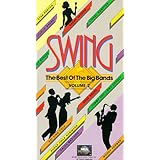
(More customer reviews)Continuing his four-volume set of VHS tapes of Swing: The Best of the Big Bands, producer George Paige selects eleven groups or individuals who were among those who contributed to the swing era (usually considered to be 1935 - 1945, though the influence of the era lasted in the early 1960s). Charlie Barnet, Gene Krupa, and Tommy Dorsey have already been featured in Volume I, but he includes them again here with new songs and adds eight other important contributors. In full-length performances he features:
*Charlie Barnet--"Skyliner," in which the band plays two melodies simultaneously, and "Jeepers Creepers," in which Virginia Maxey, almost forgotten today, solos.
*Lionel Hampton--"Baby Don't Love Me No More, with blues singer Vicky Lee--jitterbug music, a precursor to rock and roll--and the wild, less conventional "International Boogie," featuring scat and a piano solo, echoed by the band.
*Ralph Marterie, trumpet--"Trumpeter's Lullaby," and "After Midnight," including a band member who dances while playing his baritone sax, then lies on his back, rests the sax on his upraised knees, and wails.
*Gene Krupa, drums--"Boogie Blues," with Carolyn Grey singing, and Krupa engaging in drum pyrotechnics.
*Tommy Dorsey (trombone) and Jimmy Dorsey (clarinet)-- "Yes, Indeed," with singer Lynn Roberts, a jivey singer with lots of arm motion, footwork, and hand-clapping, and "Well, Git It," with Earl Barton, a dancer who engages in athletic moves and many twirls as he does soft shoe dance.
*Sugar Chile Robinson--"Numbers Boogie," in which this engaging and precocious child with a soprano voice and incredible natural piano talent plays wild boogie, hits notes with his elbow, and plays fantastic chords without looking at this hands. A very young musician, he wears shorts and is not even tall enough to have his feet touch the ground when he sits at the piano.
*Tex Beneke--"Chatanooga Choo Choo, in which he does a whistle solo and sings with a quartet backing, and "Hey-Ba-Ba-Re-Bop." Beneke took over the Glenn Miller band, for which he'd previously soloed, when he returned from World War II, and within a year, the band was given his name because of his identification with it.
*Nat King Cole--with the Benny Carter Orchestra. "Ooh Kickeroonie," in which the young Cole sings and plays effortless piano, never looking at his hands, and "Route 66, " a swinging number which features a guitar duet with his piano.
*Stan Kenton, "Eager Beaver," and "Reed Rapture. Kenton's band is unusual in its makeup, with a huge trumpet/trombone section, a few saxes, a drum, and a guitar.
*Sarah Vaughan, "Don't Blame Me," and " I Cried for You," the highlight of the entire tape. Vaughan with her almost soprano voice is so young she is almost unrecognizable, singing in a flirty "girl singer" style on the first number, which still incorporates her trademark variations and key changes, and at her early best in the second, with lots of improvisation, the use of her low register, and her incomparable timing, range, and diction in a free-wheeling recording.
*Woody Herman, clarinet--"Caldonia," in which Herman does a high-speed vocal and clarinet solo, and "Northwest Passage," which features a very young Stan Getz (who looks about twenty), and Shorty Rogers on trumpet in this wild, brassy interpretation.
As in Volume I, these almost lost black-and-white VHS tapes come from the Universal Studios archives and show the greats of swing in action. There is no historical narration--just one number followed by the next, introduced only by a placard with the name of the orchestra or star. The tapes are not available in DVD, though one would hope that MCA Home Video would recognize their importance to music history and make them available in DVD before they are lost forever. Mary Whipple
Click Here to see more reviews about: Swing: Best of Big Bands 2
 Get 37% OFF
Click here for more information about Swing: Best of Big Bands 2

0 comments:
Post a Comment