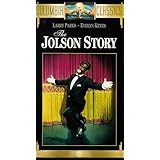
Average Reviews:

(More customer reviews)As a music historian in general, and as a performer of many of the pieces that Jolson made famous (piano for my part), and also as the son of an actor from radio and film that worked in Hollywood during Jolson's reign there, and as a collector of ancient recordings from the pre-vinyl era plus sheet music, I have had a lot of exposure to Jolson and his personna outside of these films. The view from inside is a bit sanitized, but not horrid.
Larry Parks is more than adequate for the role. Unfortunately, due to the limitations of the film media from 1946 (lack of widescreen and loss of ambience without surround sound and fx), the true essence of how BIG Jolson was on stage is lost to a degree. Jolson was not the best singer. He was not the best of lyricists. He was not the most humble of people. He had flaws that were both visible and invisible. But... HE WAS A GREAT ENTERTAINER. My Sheet Music Collection, which currently numbers over 7000 pieces, will validate that. Jolson saw his face on more sheet music covers than the bulk of many smaller publishers total output. You don't get there through simple coercion - it was his magnitude as a STAGE (not film) entertainer that got him there and kept him on top for two decades.
To some degree, while there is whitewashing and Hollywood sanitizing (such as the odd omission of Ruby Keeler's name in conjunction with her character), some of the personal flaws of Jolson are most certainly presented on screen. A more personal look from this decade would show a very troubled man with blatant insecurities, yet still quite likable. At the very least, this biopic was certainly better than some of that time, including the nearly totally fictitious Cole Porter mishap (discussed in D'Lovely). Note also that only Jolson and Fanny Brice have had no less than two consecutive biopics made about them. The incidents are otherwise not totally contrived, but some are a bit out of sequence, as is the music. I would guess the use of Rainbow On My Shoulder as a piece from the Jazz Singer (it was actually in The Singing Fool) was to get around Warner copyright issues.
Going back to the Ruby Keeler thing, the character in this movie is called Julie Benson. This is not only historically inaccurate but downright confusing, since there is no Benson in 42nd Street or Dames, which are among her movies prominently mentioned in The Jolson Story. What is more confusing is that Keeler often referred to herself as Mrs. Jolson long after their marriage was over. Maybe it was another copyright issue with Warner, possibly since they may have owned her name at the time. If she objected, in spite of how obvious it was to the public that it was her character on screen, I don't know why.
Other omissions among this and the accompany film (Jolson Sings Again) include two missing wives, the mention that Jazz Singer was originally a vehicle for Georgie Jessel, then later stolen from Eddie Cantor, the making of the Vitaphone - A Plantation Act - a year before The Jazz Singer, the lawsuit over the plagiarism of Avalon, etc. I prefer to think of these as omissions more so than inaccuracies, but they do add a certain bias to the story when these things are known.
For all the good, there are a few flaws. Parks is NOT Jolson, but he manages to overcome that so much that he becomes Jolson part way into the film. They could have minimized his hair a bit more than was done to give a closer appearance, but his synchronization with Jolson's recorded tracks is exemplary. But... the switch between Parks' speaking voice and Jolson's singing voice is jarring at times. Further, the arrangements being played during the "ragtime era" are really the swing era arrangements used for his Decca recordings. Anybody who has heard Jolson's work on Columbia or Victor knows that he was in much better voice with a timbre closer to Parks back in the 1910s and 1920s. I suppose now that his voice could be extracted from those recordings and laid over new recorded orchestrations. Stylistically the newer arrangements for older songs don't work, but appealed to the audience of the time (my mother saw the thing four times when it came out!).
The DVD box is misleading. The film is in limited scope 2.0 stereo, not mono (is this an original or redone - knowing Sony it was contrived). There is good separation between the underscore and the center channel voices through most of it, except when Jolson's recorded tracks are used, and those are mostly mono. The color is quite beautiful and not oversaturated. Chroma correction for this restoration is fairly accurate.
Even though the film can't fully capture Jolson (you need some CDs of his early work to even approach that), it helps to explain why the "mammy factor" worked so well for him and why he is still discussed a full century after he got his start on the stage. Since the second film, Jolson Sings Again, literally starts within an hour of when the first film ends, you really need the set. It also displays Parks as a talent of his own, albeit one that was sadly taken down during the McCarthy hearings, and whose career never recovered from the association.
In any case, walk a million miles and get some smiles. Buy the films!
Click Here to see more reviews about: The Jolson Story (1946)
 Get 19% OFF
Click here for more information about The Jolson Story (1946)

0 comments:
Post a Comment