Average Reviews:

(More customer reviews)The previous reviewer excoriates (in French) the Kultur label for a host of presentation sins. It's all true -- You can't get the subtitles in any language other than English. The voices are recessed in spots (though not noticeably worse than the bulk of operas issued on DVD). Zero documentation and zero texts, and the wrong track insert.
Still, the enchantment of the music and of Minkowski and Company's realization cast its spell and inexplicably compelled me to rate this 5 stars. The intrepid Ramellian (and Offenbachian) Minkowski began his recording career with this very opera in 1988, and the revelatory Erato recording is still available as an import. He has not lost a whit of his freshness. He paces the work even more confidently, caresses it even more sweetly.
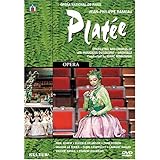
Platee is a work unto itself: a "ballet bouffon", an outlandish comic opera in the trappings of lyric tragedy, with a nasty little plot and some of the most sublime music Rameau ever brought to light. Summary of the Action: Through the scheming of King Citheron and Mercure, Platee the swamp nymph is wooed by Jupiter in order to expose and ridicule his wife Juno's raging jealousy. Platee has been described as the Miss Piggy of the swamps -- fabulous body image, vain and petulant and demanding, completely unaware that the she's a small frog stepping into a big pond.
What makes this DVD indispensible is Minkowski's impeccable musicianship -- as fleet and light of hand as it is sure -- and a production that is in every way equal to the musical virtues. The set, stage machinery and effects, photography, and above all the acting and dancing are all thoroughly delightful and bring the music vividly to life before us. So engaging on its own theatrical terms that it held the attention of my 7-year-old niece.
Paul Agnew is splendidly uninhibited and comic in the travesti role of Platee. He doesn't have quite the lyricism of the peerless Michel Senechal in the 1956 performance under Rosbaud (his fluidity missed in the entrance aria, "Que ce sejour est agreable"). But Agnew is no slouch and his big moments are all there. He is every inch the embodiment of the swamp nymph ... In the opera's final scene, where Plat'e must give vent to vengeful rage while being dragged and tossed about, Agnew's voice and command of the stage hold up very well! (But when, oh when, is Jean-Paul Fouch'court going to record this role?)
Laurent Naouri brings to Citheron his supple and strong baritone, equal to every test of dynamics and agility ... and devilishly handsome in stage persona. Yann Beuron is his worthy co-conspirator as Mercure: a supple and strong tenor, and for his part angelically handsome. He negotiates his ornaments with expressive ease, and has magnetic stage presence. You suspect he may lack the tenor's upper reaches, but that's not called for here. Mireille Delunsch is delirious and imperious as Folie, bringing down the house with her coloratura excesses. In the allegorical prologue where the singers all double roles, Beuron makes an amusing Thespis, roused from drunken slumber to sing the praises of the vine.
One of the most beautiful passages is Clarine's aria at the end of Act I, just before the storm (evoked by dazzling strings) that brings down the curtain. There are many other musical highlights, including the choruses and the occasional ensemble, where each of the principals' voices makes an appreciable impression (as at the end of Act II).
Production values are ingenious. The set for the prologue is a steep-raked theatre, inventively transformed into the bog for the opera's main action. The costumes are great fun, nicely integrated with the color scheme, and they work wonderfully with the various choreopgraphic pieces. The lighting is generally a bit murky, as befits a swamp, but not oppressive.
The choreography is the crowning glory of the production. Rameau's operas are chock-full of dance music, abounding in variety and intricacy. To leave almost all of it in for a staging is a daring feat, and the endless invention spun out for us is pure joy. The dance of the Aquilons that ends Act I keeps step with the brilliance of the renowned storm music -- aided by some inspired costumes, which are delightfully transformed for the Aquilons' return at the beginning of the following act. The "battle of the sexes" theme that runs through the dances in Act III is a little overdone, flirting with slapstick, but they do prepare us for Folie's Act III entrance to finish off her madness.
The observant viewer is given a discreet, sweetly comic choreographic touch to soften the cruelty of the opera's denouement ... so that we don't feel quite as guilty having enjoyed ourselves so thoroughly.
Click Here to see more reviews about: Rameau - Platee / Agnew, Delunsch, Beuron, Naouri, Le Texier, Lamprecht, Minkowski, Paris Opera
 Get 10% OFF

0 comments:
Post a Comment