Average Reviews:

(More customer reviews)Truly one of the most shocking but remarkable and authentic films I have ever seen in my whole life. As I watched "Windhorse," I could easily feel how the Tibetans, along with other minorities in China, such as Uygurs, were brutally maltreated by the Chinese Communists who determined to forcefully assimilate the Tibetans and other non-Chinese people into the Chinese mainstream society, which cause resentment and sometimes rage from these minorities.
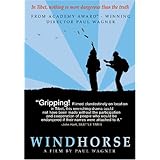
This film began in a small, peaceful village in western Tibet in three years after the Cultural Revolution ended where Dorjee, Dolkar and Pema as the children lived and played happily in carefree matter. One afternoon, two police officers went into this village while the three children played cheerfully. Both then went into the children's home and shot the children's grandfather who displayed a poster in protest against the ruthless Chinese Communists and telling the Chinese to leave Tibet. This incident struck into the hearts of the three children forever. Eighteen years later after the death of their grandfather, all three of them were grown up and took the different paths. Dolkar, a lovely and gorgeous Tibetan woman who was fluent in both Chinese and Tibetan and had a Chinese boyfriend Duan-Ping from Chengdu, was a famous singer in the nightclub in Lhasa, the capital of Tibet. She successfully signed a contract with the Chinese manager that would make her a national pop singer in China. She vowed that she would heed the "law and order" from the manager and the Communist Party so she could get huge salaries to support her family. Her older brother Dorjee, who also lived in Lhasa with her family, was a drunkard who was unemployed because he resented the Chinese people and had very little knowledge of Chinese language. Pema, the cousin of Dolkar and Dorjee, was in a monastery in western Tibet as one of the nuns. One day, the Chinese Communist government had issued a strict order to all parts of China, including Tibet, that would banned the portrait of His Holiness the 14th Dalai Lama in any institution to strengthen the Chinese control of Tibet, to determined to further "unite the thought of each individual" and to promote the "love of the motherland (China)." Later one of the nuns was arrested for the violation of this law and refusal to renounce the Dalai Lama. Angry of the Chinese, Pema and her friend shouted for Tibetan independence in the middle of the crowded market in Lhasa and were arrested by the plainclothesmen. Brutally tortured by the merciless and inclement police, Pema fell unconscious until she was picked up by Dorjee and his father after his father signed the confession paper. Meanwhile, an American tourist named Amy met Dorjee and later became friends prior to Pema's arrest. He asked his friend Lobsang, who was responsible for secretly sending the information of people arrested simply for freedom expression to India, and Amy for help. Dolkar, who was once loyal to the Chinese, was again haunted by the murder of her grandfather and decided to joined with Dorjee and his helpers to smuggle the sensitive information on Pema's arrest and brutality. They all risked their lives to do so to get the world's attention before the police were catching them.
It specifically depicts the brutally and maltreatment at the Tibetans from the hard-hearted Chinese Communists who considered the Tibetan as inferior in race and ethnicity, especially the prison, which gives us the impression that the Chinese Communists was treating the Tibetan prisoners and suspects in a very inhumane way. Jack Wagner did a marvelous job in filming this not only in Nepal but also in Tibet, where it is now part of China and the Communists do not permit anyone filming that would offend the Communists. It was a highly risky job; at least, however, he and the other crew members did create this film with the cooperation from the Tibetans who want to be safe and/or continue the political activities in Tibet and other asylum nations. Unfortunately, in present time, the Chinese Communist government prohibits this film because the Communists think it would hurt a nation's feeling and promote the secession of Tibet from the motherland (China). It will not be allowed to be viewed by 1.2 billion citizens of People's Republic of China until the Communists loses the power to hold China and becomes a truly democratic republic of the civilians, by the civilians and for the civilians. (This reminds me of Sun Yat-Sen's Three Principles of the People: nationalism, democracy and social well-being.)
I really wish there are more films about the brutality in China on other minorities, such as Uygurs. I would also like to look forward to see the film about the Baren County uprising by the righteous Uygurs who had the determination to gain independence for Uyghuristan (or East Turkistan) but ended in a victory for the Chinese Communists. (If you know the name of the movie that matches my descriptions regarding the Uygurs, please inform me by posting your suggestion in the review of "Windhorse" so I can read it, since I concealed my identity to protect myself from danger.)
Anyway, I will recommend this film to anyone who appreciates humanities and human rights around the world. Go watch "Windhorse" as soon as possible even if you are sick or tired.
Click Here to see more reviews about: Windhorse (1998)
 Get 3% OFF

0 comments:
Post a Comment