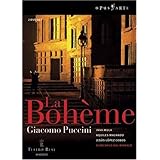
Average Reviews:

(More customer reviews)I cannot tell you how many productions of 'La Bohème' I've seen. But I can assure you that I never see it live or on DVD, or hear it in a recording, without needing a Kleenex or three at its moving conclusion. Call me sentimental and without taste, but I believe Puccini (and his librettists Giacosa and Illica) have achieved one of the most nearly perfect operas ever written. There is not an extra note -- it's actually quite a short opera -- and there are few operas whose musical underscoring of the libretto's emotional content is better. Think, for instance, of the single loud chord interrupting the bohemians' hijinks in Act IV that announces the arrival of Musetta with her news that Mimì is downstairs, dying and unable to manage the stairs up to the bohemians' garret. Or, in the final scene, the two violins depicting Mimì's faltering heartbeat. And, as this Madrid Teatro Real production's stage director, Giancarlo del Monaco, says in his booklet interview (and in the excellent set of interviews, 'Reflections', on Disc II), 'Bohème' epitomizes cinematic treatment in music. Del Monaco takes advantage of that aspect of Puccini's music by giving us a very cinematic treatment onstage. Because of the specificity of Puccini's music one is rarely, even in the crowded stage scene of Act II, unaware of where the important action is; musically, it is always at the forefront. Consequently, del Monaco is able to give us an exquisitely thought-out staging that is both complex and truthful; there are many small details that enrich the narrative. The only misstep -- although I can see why he did it -- is at the end of the final scene when, after Mimì has died and Rodolfo has rushed to her bedside, the garret's walls fly up to reveal a beautifully lit backdrop of the streets of Paris into which Rodolfo then wanders, all alone, as if to show us what lies ahead for the grieving poet.
Musically, this production is top-notch. Jésus López Cobos is a superbly attentive opera conductor and his Teatro Real orchestra play beautifully. López Cobos manages the scherzando bits (e.g., the opening scenes of both Acts I and IV) and the emotionally resonant bits (e.g., Rodolfo/Mimì scene at the end of Act I, the entire Act III scene with the duet and quartet, the opera's final scene) with equal sensitivity and style. As for the singers, this is undoubtedly Inva Mula's show. She plays Mimì as not quite as naïve as often seen, and her portrayal of Mimì's physical deterioration and death are emotionally touching. And all with lovely control of her lovely voice. It does not hurt that she is a physically beautiful woman. Very nearly her equal is a tenor not previously known to me, Aquiles Machado, whose Italianate tenor is perfect for the role. He is a bit of a butterball, but that quickly becomes only a minor deficit. He is an artistic singer and a good actor who plumbs the emotional depths of the role.
Laura Giordano is a sexy-looking woman (with very good legs, which she shows to great advantage in Act II) whose soprano is not as rich as one might wish in Musetta's waltz song. Later, though, she comes into her own. Her acting is realistic and effective. Really effective is the big, handsome Marcello, Fabio Maria Capitanucci, whose robust yet subtle baritone is particularly effective in the latter part of the opera. His scene with Rodolfo in Act III is superb. David Menéndez is excellent as Schaunard; his physical agility in the horseplay scenes is particularly effective. Felipe Bou, in his thick glasses, makes a awkward but lovable philosopher, Colline. He makes the most of his little aria in Act IV, 'Addio, vecchia zimarra'.
The opera has been set in 1890s Paris, some sixty years or so after the time of Murger's 'Scènes de la vie bohème', and this makes absolutely no difference to the feel of the opera except that there are some proto-modern touches like an old-style typewriter and some electric lights in the Café Momus scene (but candlelight in the garret of the poor artists). The quite beautiful sets and costumes are by Michael Scott and the creative and very effective lighting, influenced by del Monaco's cinematic approach, is by Wolfgang von Zoubek. The stage actions of the extras (e.g., the drunk in Act III, stilt-walkers and jugglers in Act II) are inventive; I did wonder how the revealingly dressed prostitute outside the Act III inn did keep from freezing to death.
The DVD was taken from live performance and the final bows are greeted with long and very enthusiastic applause by the Teatro Real audience. This is a Region 0 DVD (playable in all regions) and the fine sound is in either stereo or surround sound. Videography (using eight cameramen, according to the credits) and editing are simply superb; Robin Lough's direction for television is above reproach.
This is a superior DVD that will be around a long time, deservedly so. I loved every minute of it.
Scott Morrison
Click Here to see more reviews about: Puccini - La Boheme (2006)
It seems hard to believe that even during the last century Puccini was greatly underrated by many as a classical composer and indeed his music was considered to be far too melodic. Fortunately today, Puccini's operas have found their rightful place in the repertoires of all the leading Opera companies around the world.This production of La Bohème remains true to the period and the libretto of the original score. The director of music, Jesús López Cobos, is to be congratulated for not making changes for changes sake. The cinematic technique employed, particularly for close ups, brings the viewers into the story almost as participants whilst at the same time the opera is clearly being performed on stage as one would expect.Inva Mula and Aquiles Machado give masterful performances as Mimi and Rodolfo, as do Laura Giordano, Fabio Maria Capitanucci and, indeed, the rest of the cast, bringing the characters to life and doing full justice to Puccini's magnificent score.A well known anecdote has it that the late King George V, when talking to Sir Thomas Beecham, remarked that La Bohème was his favourite opera as it was the shortest one he knew of. It is not, of course, the shortest opera but the quality of the music with its wonderful arias certainly makes the time pass all too quickly.
 Get 10% OFF
Click here for more information about Puccini - La Boheme (2006)

0 comments:
Post a Comment